
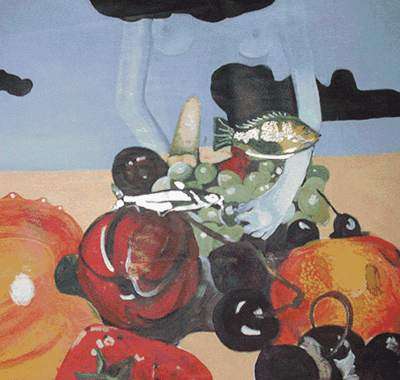
The Power of Transformation
With its transformative power, the surrealist perspective suggests that we can fundamentally change our outlook. Just as every organic being continuously evolves while retaining its essence, our society is constantly in flux, ready for new perspectives and ideas to take root. Surrealism is the artistic recognition of this constant state of change.
Embracing Modern Materialism
Modern science’s revolutionary affirmation that nature operates dialectically, rather than metaphysically, challenges our preconceived notions. It is a radical shift from the idea of nature moving in an eternally uniform, repeating cycle. Darwin challenged the metaphysical concept of man, proving we are products of evolution—a process that can only be fully grasped through understanding how things shift and change over time.
In contrast to other philosophies, modern materialism embraces recent advances in natural science, acknowledging that even celestial bodies, like organic species, undergo cycles of formation and dissolution. This fluid, ever-evolving understanding of reality is the bedrock upon which Surrealist thought is built. It tells us that nothing is truly fixed; everything is capable of being reimagined.
The ‘Crisis of the Object‘: A Rebellion Against the “Price Tag”
In the mid-1930s, André Breton frequently referred to “The Crisis of the Object.” This was a call for a new orientation toward the things in our daily lives. In a conventional society, we are taught to see objects only through their “utility”—how they can be used, sold, or bought. We stop seeing the object itself and start seeing only its function or its price tag.
The Surrealists sought to provoke a “crisis” in this way of thinking. They wanted to strip objects of their everyday roles. By inventing or reimagining objects that deviated from their usual physical forms and accepted functions, they broke the spell of consumerism. The external object could then become an extension of our subjective self, fostering a new awareness of reality.
Philosophically, this interaction entails an exchange between mind and matter. By making a mundane object “useless” or “irrational,” Surrealism transforms the world from a collection of products into a tapestry of shapes, colours, and mysteries. It is an act of anti-materialism—a refusal to let the market define what is real or valuable.
Influence and Legacy
The legacy of Surrealism extends beyond the canvas into the realms of philosophy and our very perception of existence. By rejecting conformity and exploring the “crisis of the object,” Surrealists brought together people from diverse cultures under a shared intellectual movement. They demonstrated that the boundaries of creativity are ever-expansive, waiting for those who dare to venture beyond the confines of convention.
This movement reminds us that we are not just passive observers in a world of “things.” We have the power to act directly upon the material world, changing how we see it and, ultimately, how we live within it.
🖼 Related Journal Pages & Creative Work
Explore how surrealism has influenced my art practice: